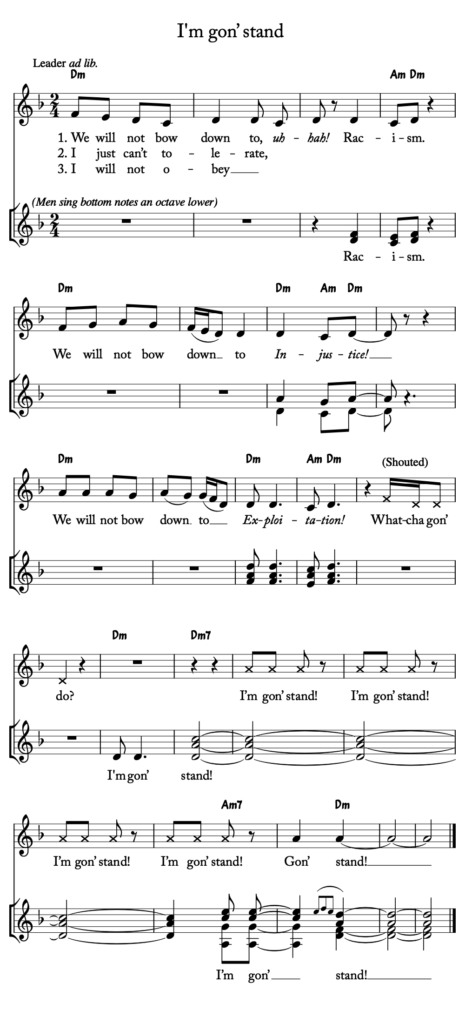
I’m Gon’ Stand

Download PDF file of I’m Gon’ Stand
Download MuseScore file of I’m Gon’ Stand

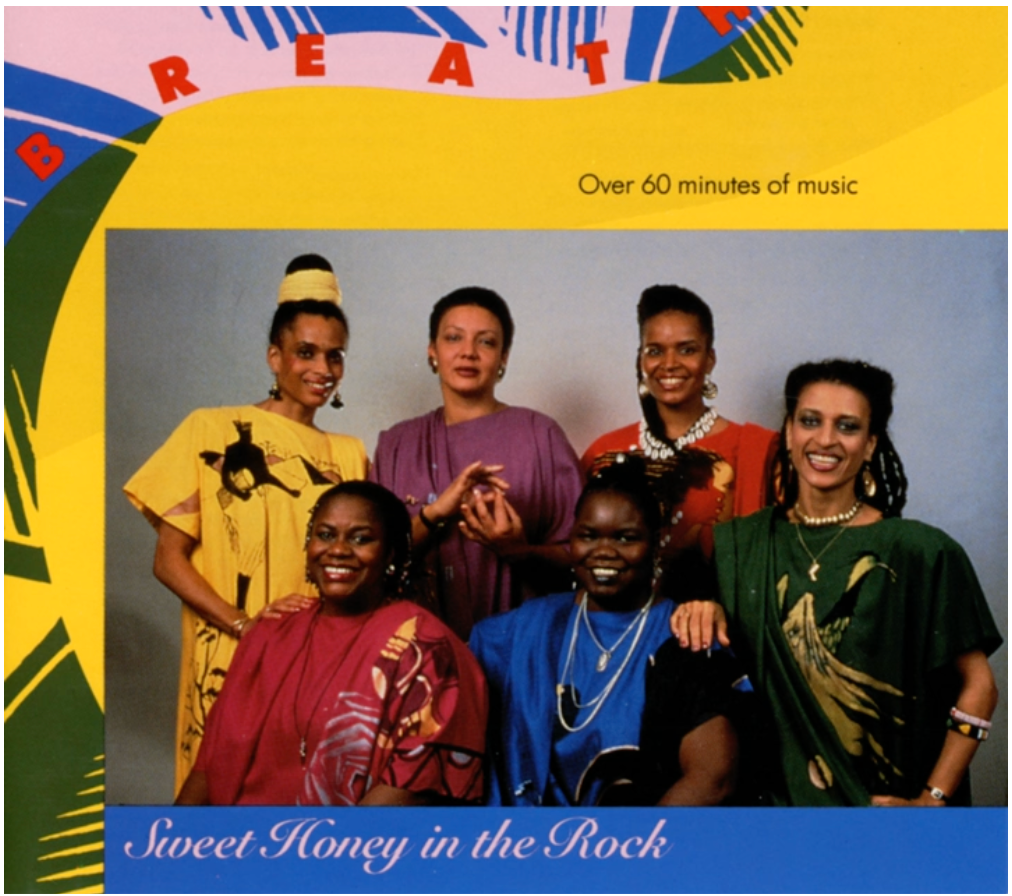
This call and response song requires a strong, energetic leader and a back-up chorus who can hold to the harmony. When the singers can hold their parts, this is very effective but it’s not a good song for “sing-along”. I have given a bare bones version of the song and labeled the leaders part, “ad lib.” If you listen to the version by Sweet Honey in the Rock, below, you will get an idea of how flexible this can be.
Here is a great rendition of I’m Gon’ Stand by Sweet Honey in the Rock.
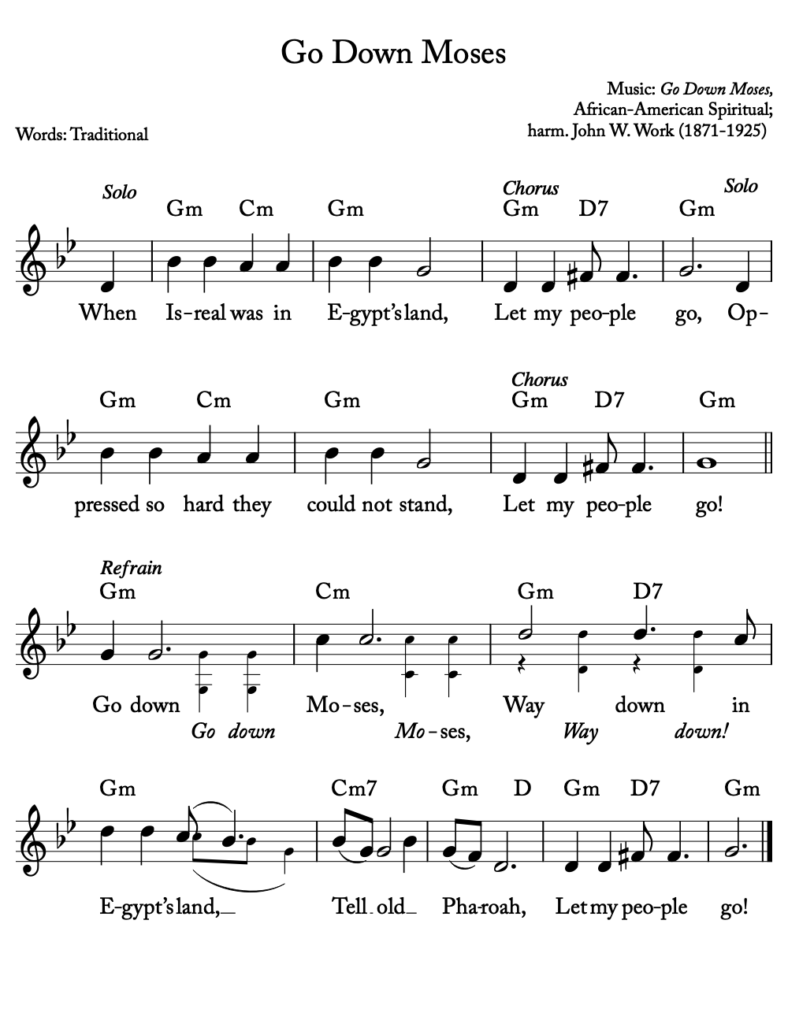
Go Down Moses (When Israel was in Egypt’s Land)

Download PDF of Go Down Moses
Downlosd PDF of band arrangement of Go Down Moses
Download MuseScore files (lead sheet and band arr.) for Go Down Moses

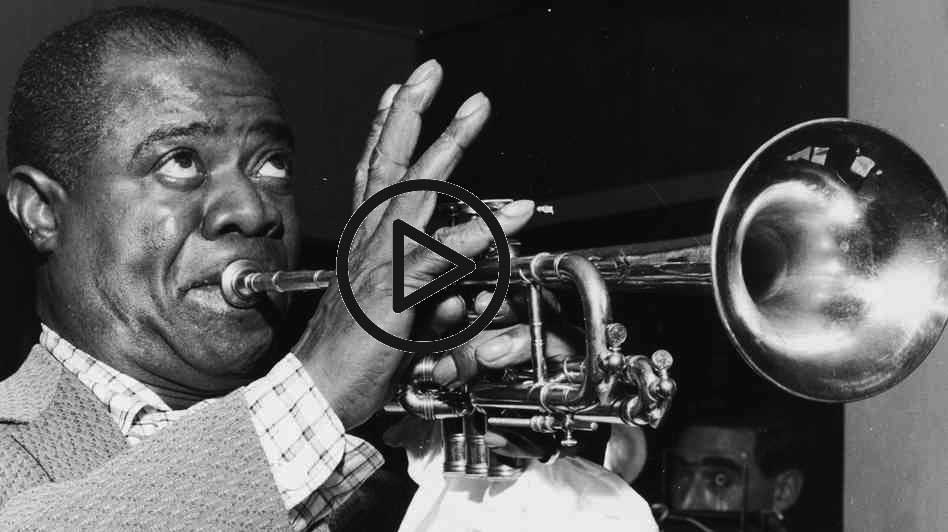
Go Down Moses! You can sing this in a straight up choral/gospel style, as a New Orleans style jazz number, with solo improvisations for band, you can write new verses to suite the needs of the moment, really there are so many possibilities that i can’t list them all. Plus, almost everybody knows the chorus and they can join in. I love the version by Louis Armstrong that I have included below.

I haven’t written a band arrangement for this and I am not sure I really am up to it. This may be one of those songs that just has to be improvised. Maybe I’ll write out a bass line with chords and the melody and let you all take it from there.

Go Down Moses lead sheet

Here is the Louis Armstrong version.

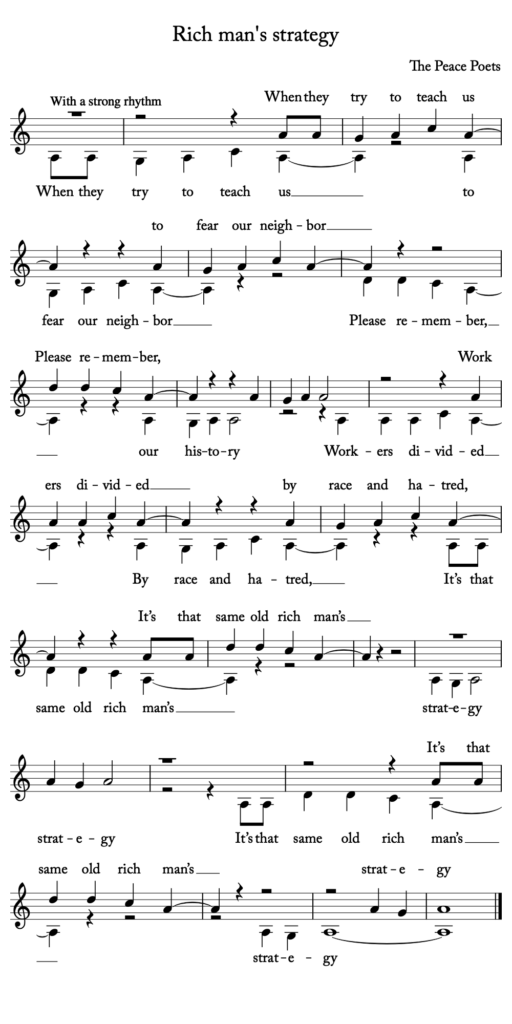
Rich Man’s Strategy

Download PDF of Rich Man’s Strategy

This is a very effective chant. It is primitive in the sense that it sticks to the pentatonic scale* (or, actually, the tetratonic scale, in that it uses only four notes). It works well with a drone on LA**, and some kind of very repetitive rhythmic ostinato. In the PDF of this song I have added in a steady drum beat.

If the response part to this is sung by a group of singers, there is a lot of room for harmonic improvisation; in fact, because of its harmonic simplicity, this would be a good song for less experienced singers to get a start on improvised harmony. If you stick to the notes in the pentatonic scale, you can’t really sing a note that is “wrong.”

*The pentatonic or gapped scale skips FA and TI. In other words the scale goes DO RE MI SO LA (DO). In this song, you start on LA instead of DO, so it goes: LA DO RE MI SO (LA).
**In movable DO solfege, DO is the tonic of the major scale and LA is the tonic note of the minor scale.

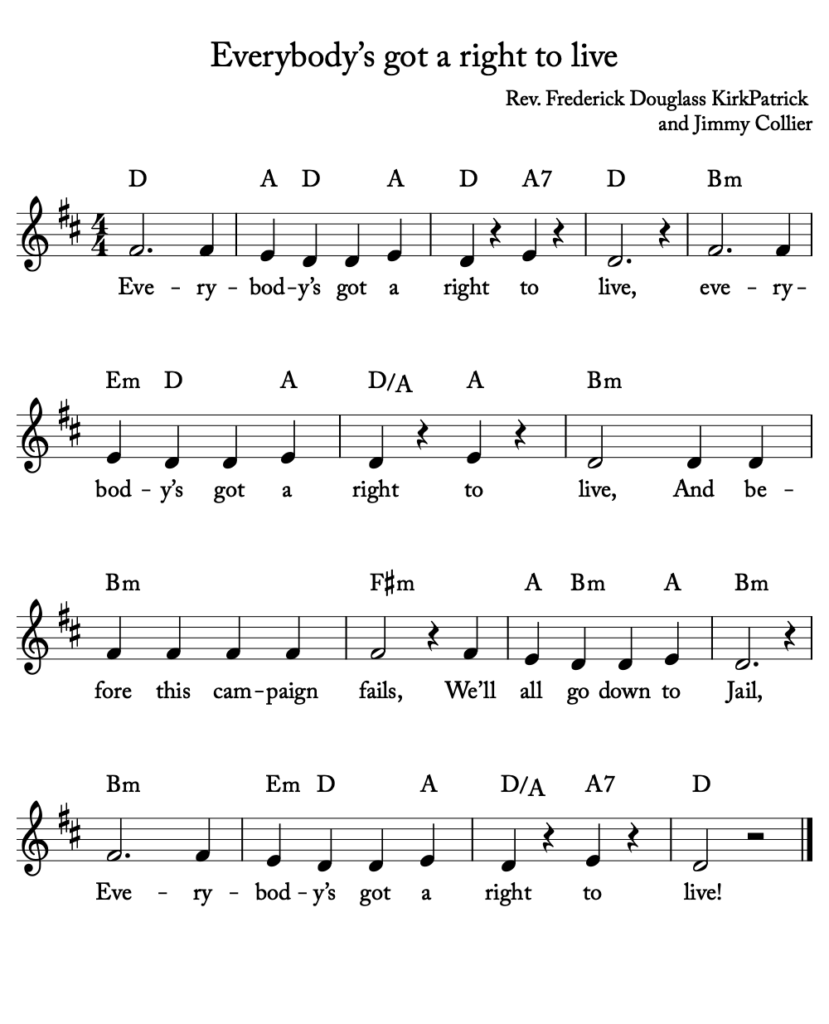
Everybody’s Got a Right to Live

Download PDF file of Everybody’s Got a Right to Live!

This song was written for The March on Washington in 1968. It was originally directed at the way racism resulted in poverty. Both the original words and the simplified words are included on the PDF. It’s a great song when you have a bunch of people who don’t know many songs. The words are simple and the tune is easy to learn in a call and response way.


The is a video from the Poor People’s Campaign in 2021

Here are Rev. Frederick Douglass KirkPatrick and Jimmy Collier, who wrote this song, singing the original version in 1969.

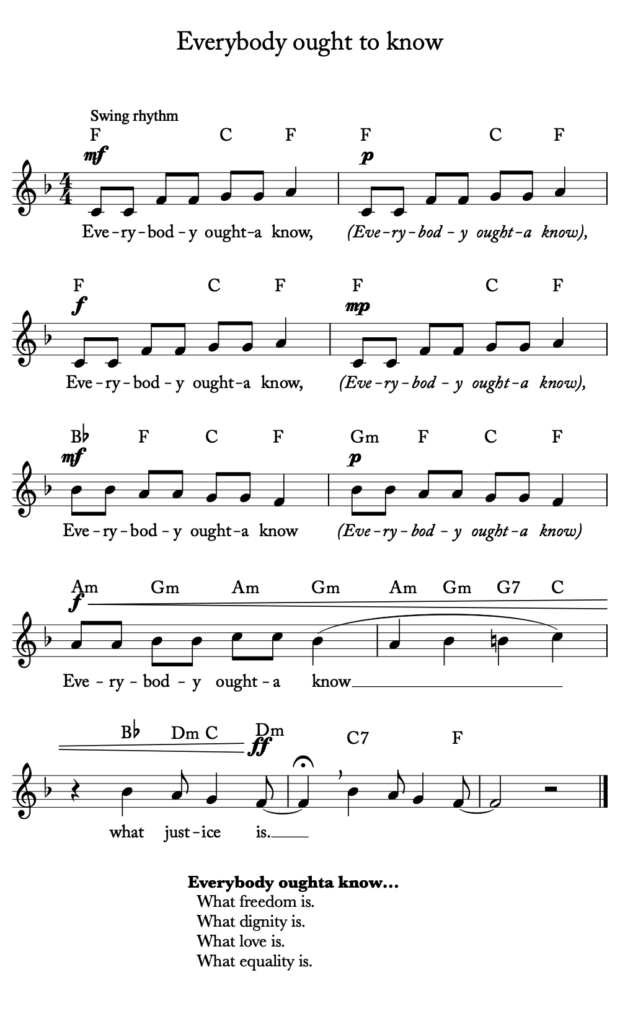
Everybody ought to know

Download PDF of Everybody Ought to Know
Download MuseScore lead sheet for Everybody Ought to Know

Everybody Ought to Know is a good song for kids. I have added some suggested chord symbols and raised the key from C Major to F major (otherwise it starts on a low G and children should learn to use the higher registers of their voices!). The kids here sound great (if someone has some money to send them to tune the piano, I bet they would love it!) and the song has a lot of potential. It’s a song for which you can make up new verses as needed, add harmonies (as able), add percussion, clapping, etc., and add simple dance and mime movements.

With kids, I think this should be sung antiphonally, with half the kids singing the “call” and the other half singing the “response”; then, everybody sings the last line together. It would be easy to write a simple, two-part harmony for the last line if your kids are up to it.

Here is a YouTube video of by the kids from the Erickson Elementary School in Ypsilanti, Mississippi singing Everybody Ought to know.

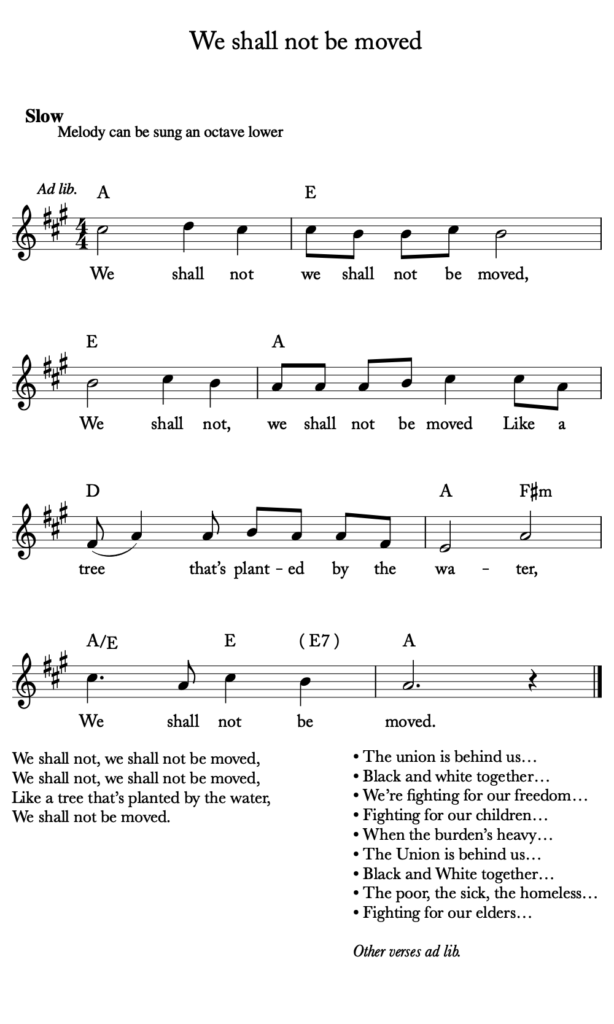
We shall not be moved

Download PDF of We Shall Not Be Moved

We Shall Not Be Moved was adapted by the labor movement in the 1930s and in the 1950s and ’60s was sung in Civil Rights movement. It originates from, I shall not be moved, an African-American slave spiritual, hymn, and protest song dating to the early 19th century. It was likely sung originally at revivalist camp-meetings as a slave jubilee. [Information from Wikipedia]

I like this version of Mavis Staples singing We Shall Not Be Moved because it has an actual video of Mavis singing and also includes her telling a great story about singing this in the late 1950s in the Civil Rights movement.

However, this recording of Mavis singing We Shall Not Be Moved may be better, musically.

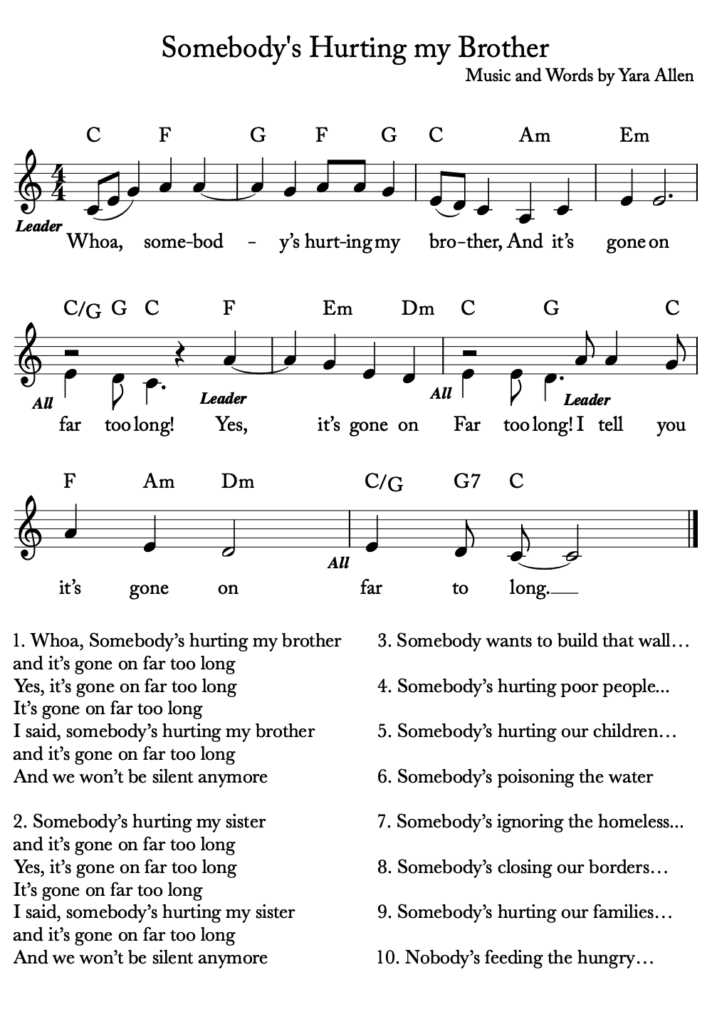
Somebody’s Hurting My Brother

by Yara Allen

Download PDF of Somebody’s Hurting My Brother with harmony parts

Somebody’s Hurting My Brother is a wonderful call and response song by Yara Allen* that needs a good strong leader. The response is simple enough for just about anybody, but there are lots of possibilities for more experienced singers to harmonize and add interesting clapping or other percussion rhythms. We The downloadable PDF version has a suggested harmony for the response in four parts.

Yara Allen teaching, Somebody’s Hurting My Brother


*Yara Allen is a singer, songwriter, poet, and musician, and a native of Rocky Mount, NC. She is also the Director of Theomusicology and Cultural Arts with Repairers of the Breach (Goldsboro, NC) and Co-Director of Theomusicology and Movement Arts with the Poor People’s Campaign: A National Call for Moral Revival.

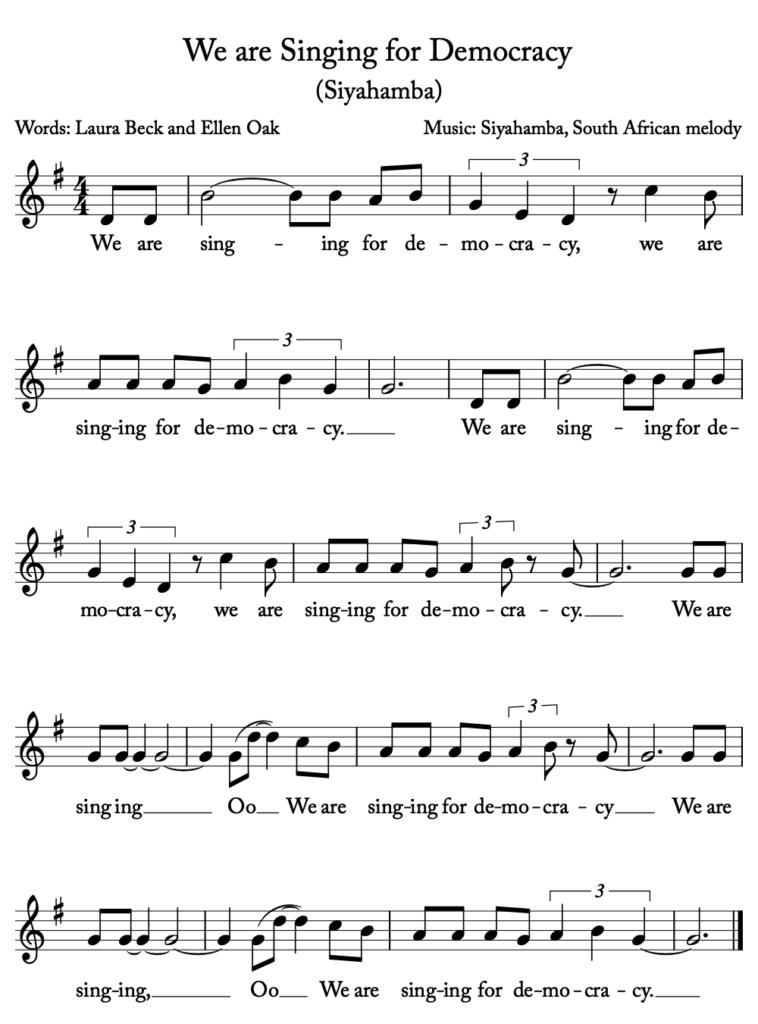
We are Singing for Democracy (Siyahamba)

Download PDF of We are Singing for Democracy
Download PDF of Siyahamba with full harmony and words in English, Spanish and Zulu

Siyahamba is a song from South Africa. Here, Ellen Oak and Laura Beck have rewritten the English words to fit the need of this moment. The downloadable PDF has the original version in English, Spanish and Zulu, as well as the version with “We are Singing for Democracy.”

Here are the Original words in all three languages:
Original Zulu:

Siyahamba ekukhanyeni kwenkos.
Siyahamba ekukhanyeni kwenkos (repeat)
CHORUS
Siyahamba, ‘hamba. Siyahamba, (ooh) ‘hamba
Siyahamba ekukhanyeni kwenkos.

English:
We are marching in the light of God, we are marching in the light of God. (repeat)
CHORUS
We are marching, marching, we are marching, (ooh) marching,
We are marching in the light of God.

Spanish:
Marcharemos en la luz de Dios, Marcharemos en la luz de Dios.
Marcharemos, ’remos, Marcheremos, (Uuu), ’remos,
Marcharemos en la luz de Dios.

This version is the same arrangement as the one in the PDF.

Listen to the harmony on this MP3 file…

Here is the Mwamba Children’s Choir singing Siyahamba

Pay Me My Money Down

Download the PDF of Pay Me My Money Down

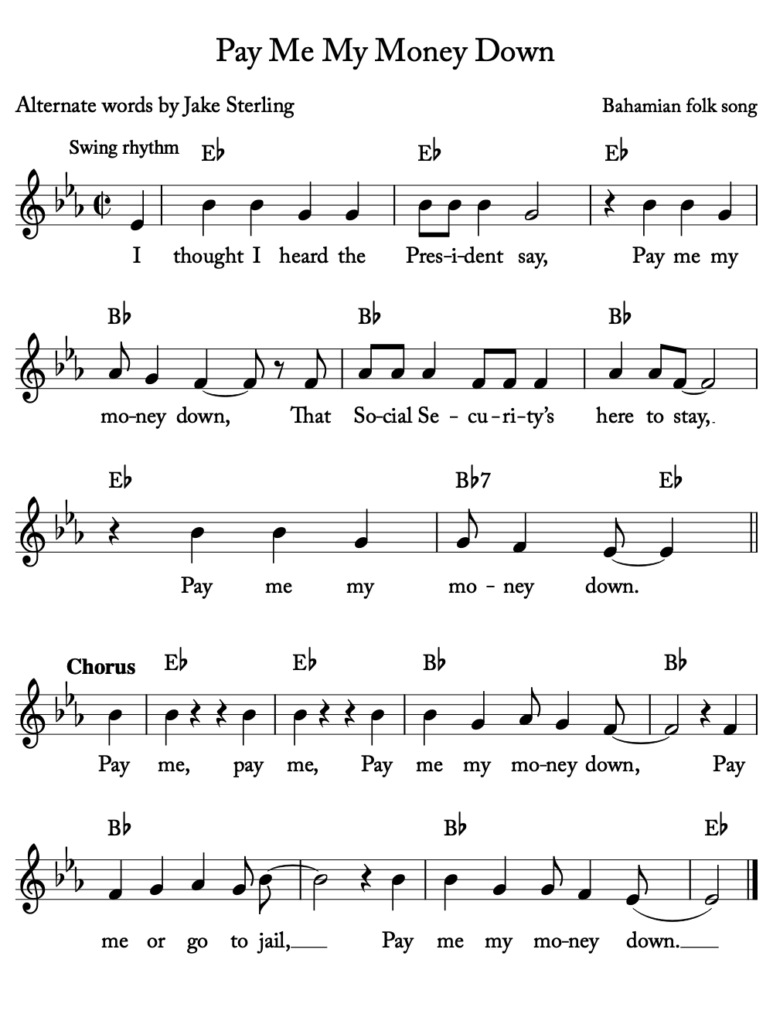
This song will really get people dancing and clapping! Bring a tambourine! If you are lucky enough to have a band that has some experience with New Orleans jazz, they can go to town. I love Bruce Springsteen’s recording of this. You can listen (and see) it on the YouTube link below. The downloadable PDF has some simple ideas for harmonization.

Some suggestions for alternative lyrics—or you could write your own!

I thought I heard the President say,
Pay me my money down,
“Social Security’s here to stay.”
Pay me my money down!

Well, Elon Musk with his chain saw,
Pay me my money down,
He stole my money and he broke the law,
Pay me my money down!

They cut off U-S-A-I-D,
Pay me my money down,
Now Donald says, “That ain’t on me!”
Pay me my money down

And the ICE-man took me from my street,
Pay me my money down,
El Salvodor jails got no bed sheet,
Pay me my money down.

If you tell Donald Trump his word ain’t law,
Pay me my money down,
He’ll throw his dinner up on the wall,
Pay me my money down.

When Donald Trump is finally out,
Pay me my money down,
I’ll spend my money and I’ll sing and shout,
Pay me my money down.

Bruce Springsteen and his band singing Pay Me My Money Down