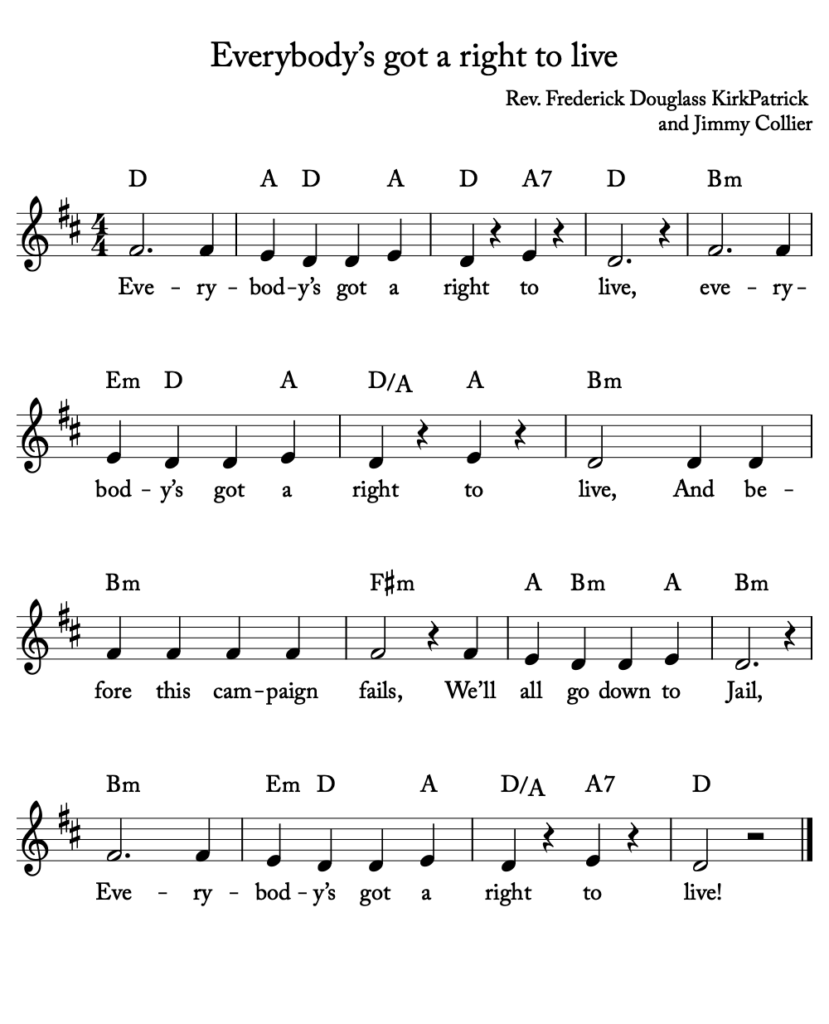
This song was written for The March on Washington in 1968. It was originally directed at the way racism resulted in poverty. Both the original words and the simplified words are included on the PDF. It’s a great song when you have a bunch of people who don’t know many songs. The words are simple and the tune is easy to learn in a call and response way.
The is a video from the Poor People’s Campaign in 2021
Here are Rev. Frederick Douglass KirkPatrick and Jimmy Collier, who wrote this song, singing the original version in 1969.
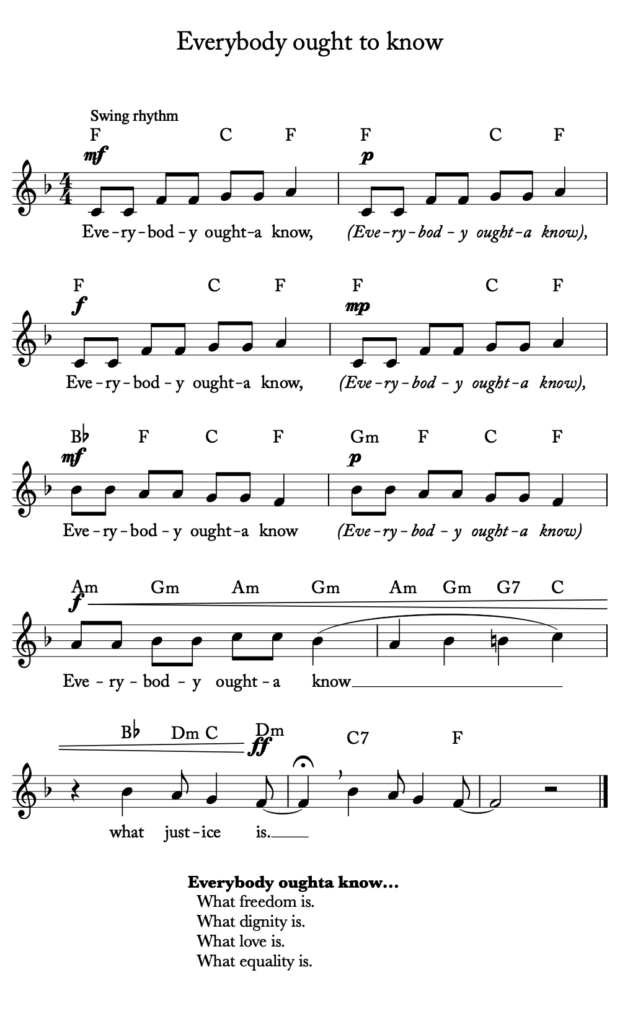
Everybody Ought to Know is a good song for kids. I have added some suggested chord symbols and raised the key from C Major to F major (otherwise it starts on a low G and children should learn to use the higher registers of their voices!). The kids here sound great (if someone has some money to send them to tune the piano, I bet they would love it!) and the song has a lot of potential. It’s a song for which you can make up new verses as needed, add harmonies (as able), add percussion, clapping, etc., and add simple dance and mime movements.
With kids, I think this should be sung antiphonally, with half the kids singing the “call” and the other half singing the “response”; then, everybody sings the last line together. It would be easy to write a simple, two-part harmony for the last line if your kids are up to it.
Here is a YouTube video of by the kids from the Erickson Elementary School in Ypsilanti, Mississippi singing Everybody Ought to know.
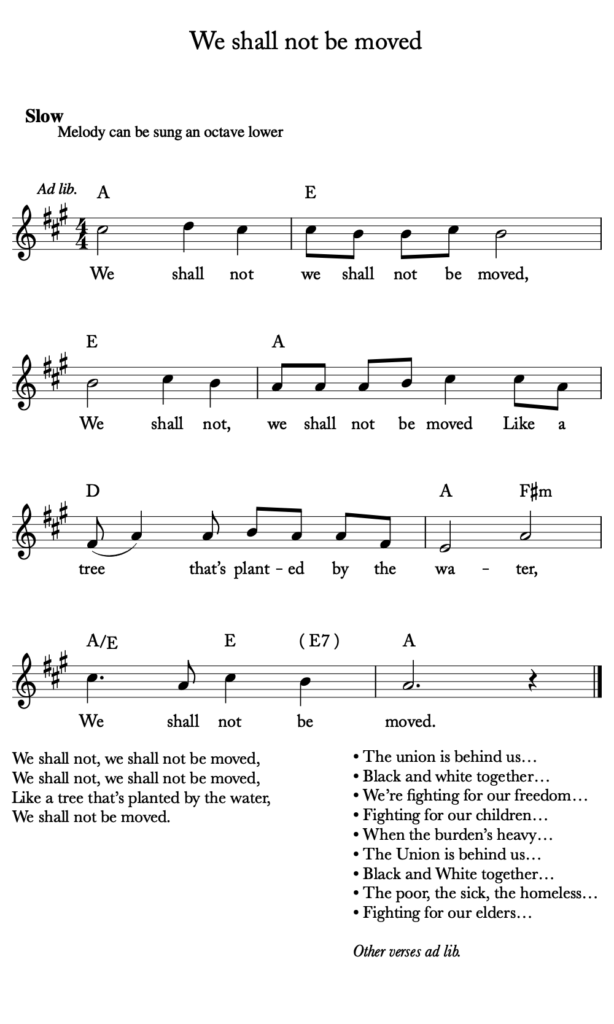
We Shall Not Be Moved was adapted by the labor movement in the 1930s and in the 1950s and ’60s was sung in Civil Rights movement. It originates from, I shall not be moved, an African-American slave spiritual, hymn, and protest song dating to the early 19th century. It was likely sung originally at revivalist camp-meetings as a slave jubilee. [Information from Wikipedia]
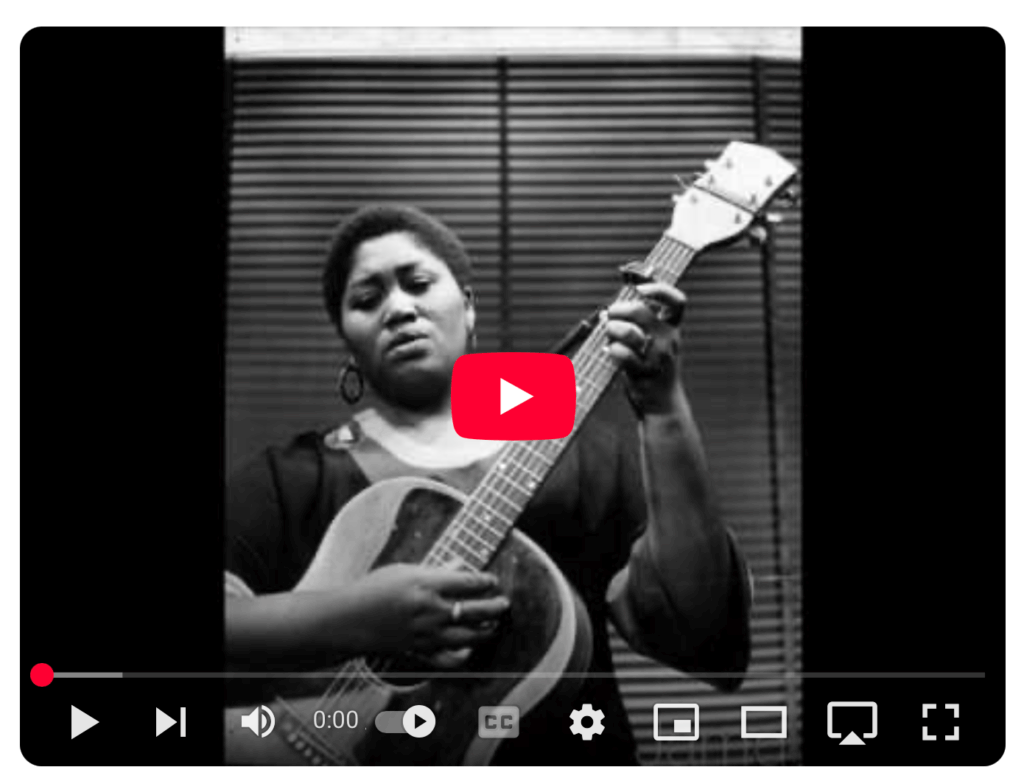
I like this version of Mavis Staples singing We Shall Not Be Moved because it has an actual video of Mavis singing and also includes her telling a great story about singing this in the late 1950s in the Civil Rights movement.
However, this recording of Mavis singing We Shall Not Be Movedmay be better, musically.
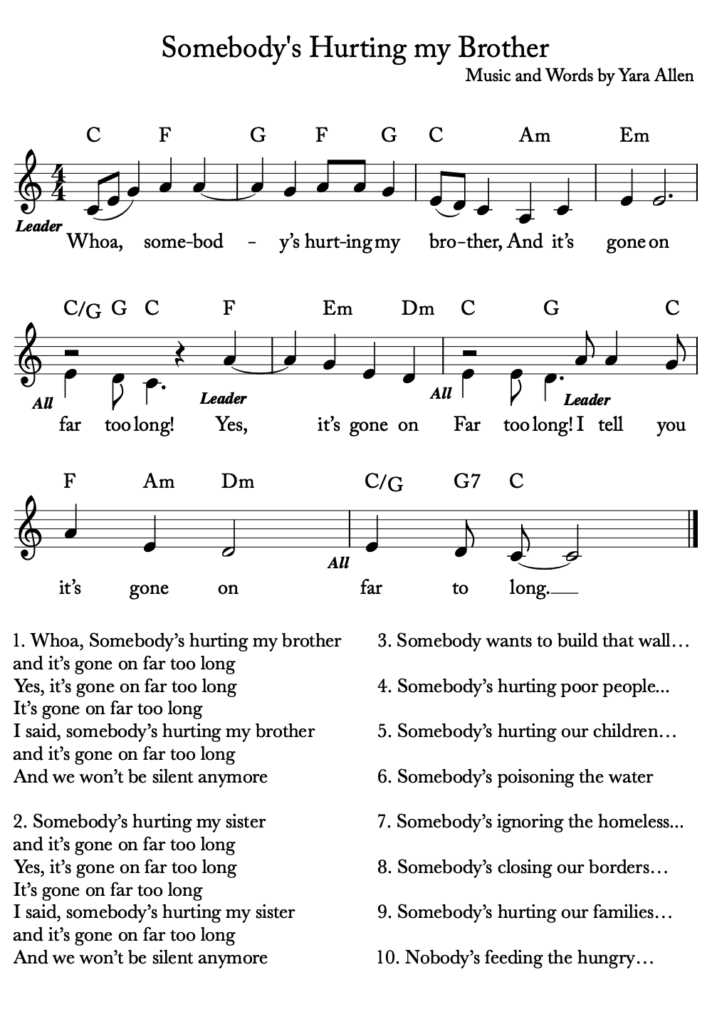
Somebody’s Hurting My Brother is a wonderful call and response song by Yara Allen* that needs a good strong leader. The response is simple enough for just about anybody, but there are lots of possibilities for more experienced singers to harmonize and add interesting clapping or other percussion rhythms. We The downloadable PDF version has a suggested harmony for the response in four parts.
Yara Allen teaching, Somebody’s Hurting My Brother
*Yara Allen is a singer, songwriter, poet, and musician, and a native of Rocky Mount, NC. She is also the Director of Theomusicology and Cultural Arts with Repairers of the Breach (Goldsboro, NC) and Co-Director of Theomusicology and Movement Arts with the Poor People’s Campaign: A National Call for Moral Revival.
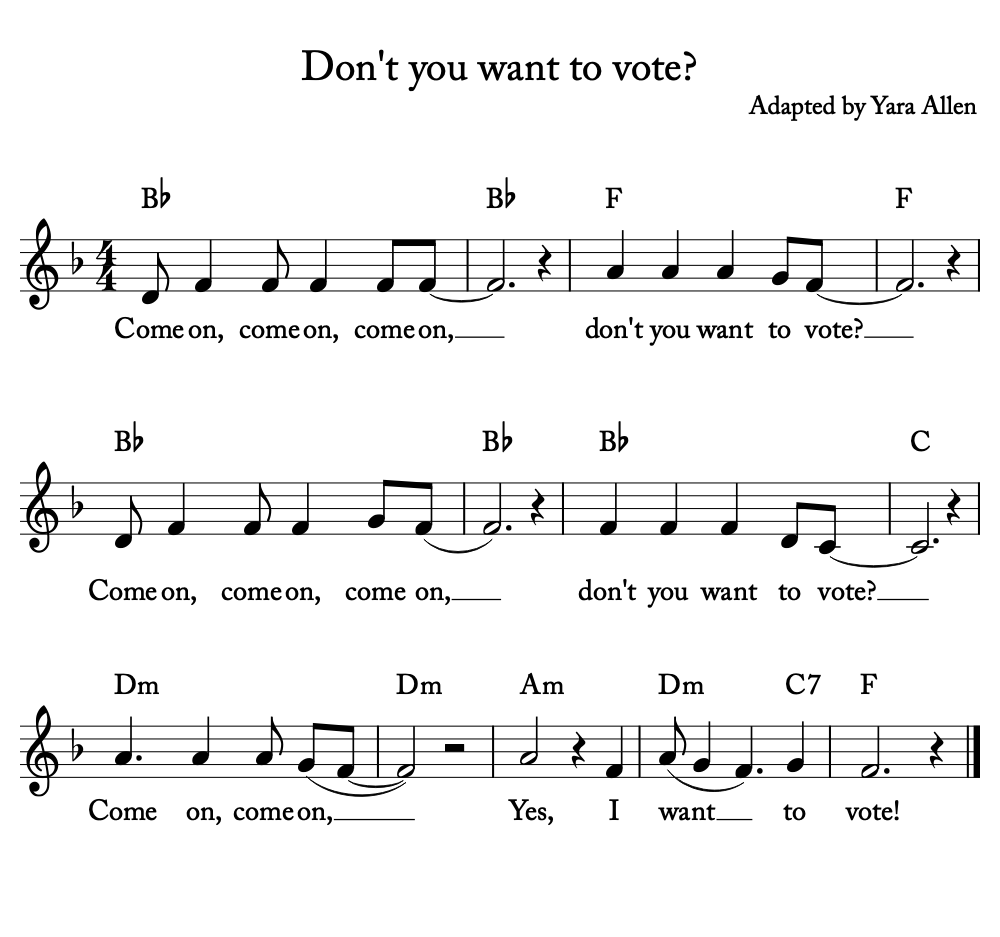
Come on, come on, come on Don’t you want to vote? Come on, come on, come on Don’t you want to vote? Come on, come on, come on Don’t you want to vote? Yes, I want to vote!
Have you registered somebody? Don’t you want to vote…
Will you meet me at the polling place! Don’t you want to vote…
Go and raise your voices! Don’t you want to vote…
Yaray Allen Leading her song, Don’t You Want to Vote?
This song cries out for percussion! It’s pretty simple, like all great dance music. In fact, it makes you want to dance in the streets. I would use it the way marching bands use a cadence in the percussion section: as a lively, dancing filler between other songs. It needs a charismatic leader to really bring people in.
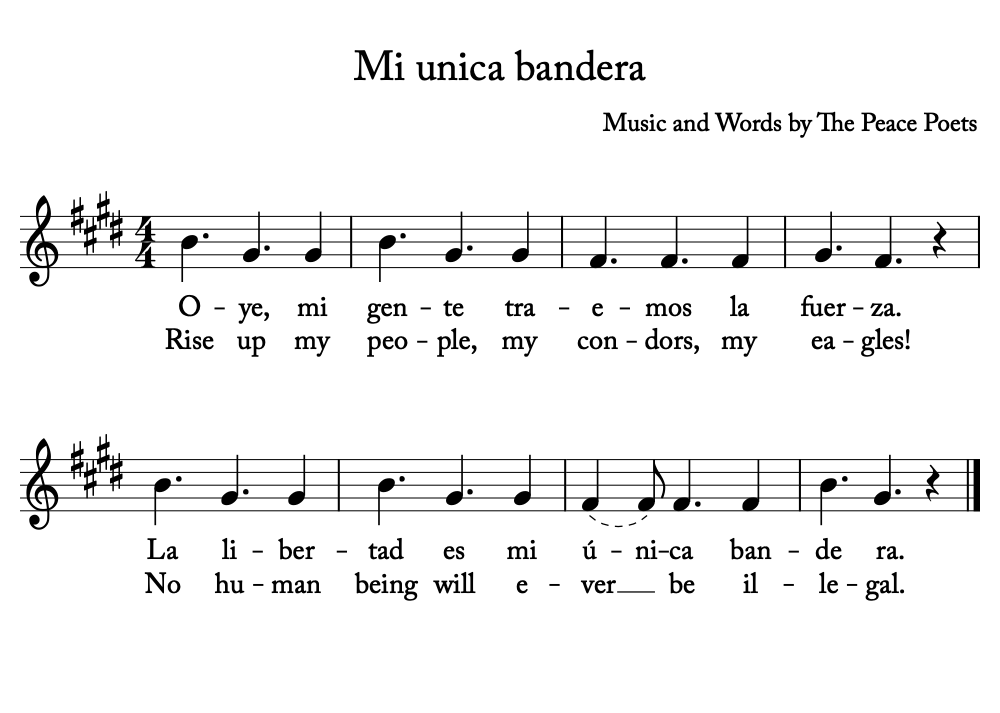
The Peace Poets are a collective of artists that celebrate, examine and advocate for life through music and poetry. Their style emphasizes lyricism, rhythm and authenticity. They hail from the Bronx and have been rocking the mic since 2005.
Translation of the Spanish words: Listen, my people, we bring the power. Freedom is my only flag. Translation of English words: ¡Arriba, pueblo mío, cóndores míos, águilas mías! Ningún ser humano será jamás ilegal.
This is a great song to sing at a march or any action where people might get arrested, ICE is present, there is danger from hecklers, or at any action that is focused on the danger we are all in because of Trump and the forces of Authoritarianism. It’s a simple melody and one that can be enhanced by clapping and other percussion, and by improvised harmonization.
Here is a YouTube video that was made at at The Poor People’s Campaign: A National Call for Moral Revival Theomusicology and Movement Arts Gathering in Raleigh, NC February 2018.
Another great song from the Civil War—though this one may be more familiar to many as…
“Glory, glory hallelujah, Teacher hit me with a ruler, Knocked her on the bean with a rotten tangerine And she sunk like a German submarine.”
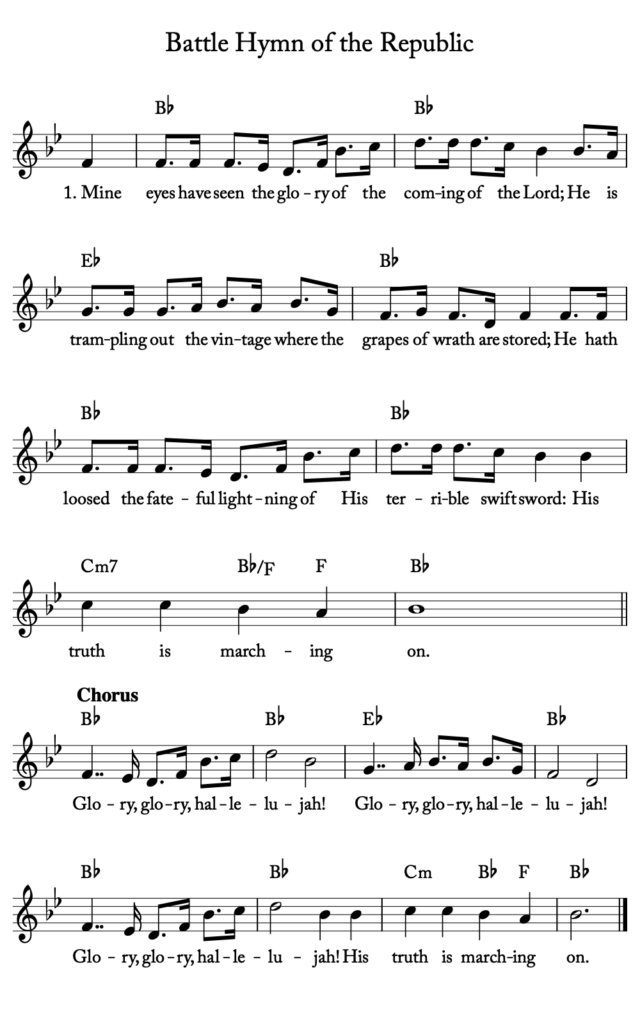
The original tune for this song was, John Brown’s Body. A song about the abolitionist, John Brown, who was put to death after a raid and incitement of a slave rebellion at Harpers Ferry, Virginia in 1859. If we allow ourselves to feel it, this song, with it’s simple, repetitive rhythm and it’s three-chord harmony, is still a stirring evocation of the righteousness we long for as a people.
The Battle Hymn of the Republic (LYRICS)
1. Mine eyes have seen the glory of the coming of the Lord; He is trampling out the vintage where the grapes of wrath are stored; He hath loosed the fateful lightning of His terrible swift sword: His truth is marching on.
(Chorus) Glory, glory, hallelujah! Glory, glory, hallelujah! Glory, glory, hallelujah! His truth is marching on.
2. I have seen Him in the watch-fires of a hundred circling camps, They have builded Him an altar in the evening dews and damps; I can read His righteous sentence by the dim and flaring lamps: His day is marching on.
3. I have read a fiery gospel writ in burnished rows of steel: “As ye deal with My contemners, so with you My grace shall deal;” Let the Hero, born of woman, crush the serpent with His heel, Since God is marching on.
4. He has sounded forth the trumpet that shall never call retreat; He is sifting out the hearts of men before His judgment-seat; Oh, be swift, my soul, to answer Him! Be jubilant, my feet! Our God is marching on.
5. In the beauty of the lilies Christ was born across the sea, With a glory in His bosom that transfigures you and me. As He died to make men holy, let us die to make men free, While God is marching on.
This is a great, patriotic song from the Civil War. It can be sung indoors with a piano or, if you are lucky enough to have some band instruments for accompaniment, sing it at a rally or demonstration. I love this kind of music and have discovered rather late in life that I am a radical, left wing, commie, pinko, gay, effete intellectual snob because I am, underneath it all, a devout patriot who believes in the founding principles our nation is built on.
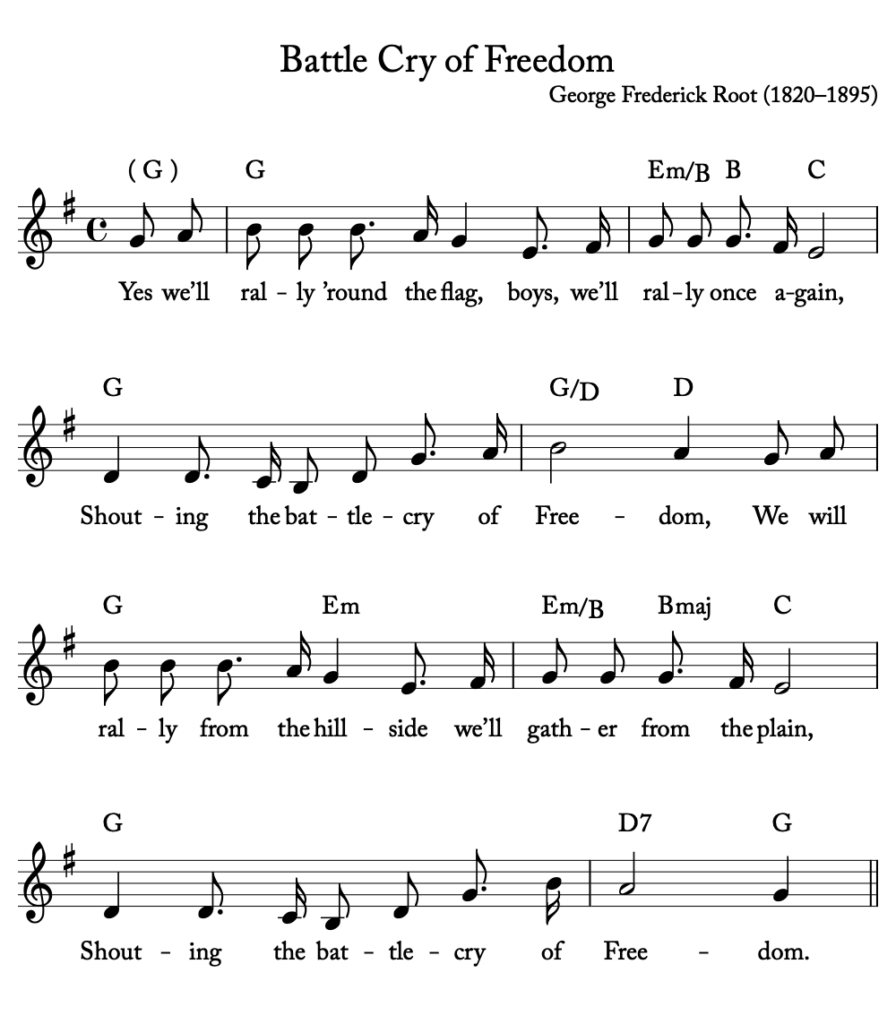
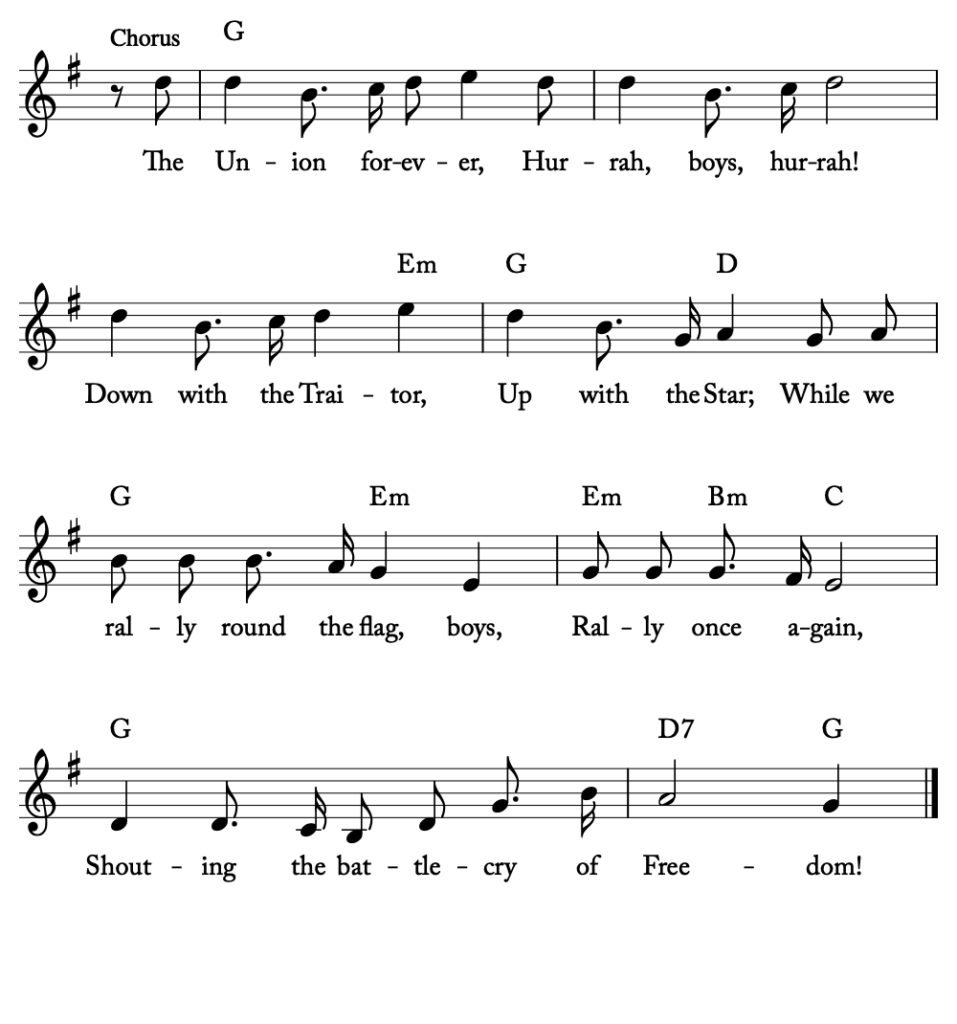
Battle Cry of Freedom (Lyrics)
1. Yes we’ll rally round the flag, boys, we’ll rally once again, Shouting the battle-cry of freedom, We will rally from the hillside we’ll gather from the plain, Shouting the battle-cry of freedom.
CHORUS The Union forever, Hurrah, boys, hurrah! Down with the Traitor, up with the Star; While we rally round the flag, boys, rally once again, Shouting the battle-cry of freedom!
2. We are springing to the call for Three hundred thousand more, Shouting the battle-cry of freedom, And we’ll fill the vacant ranks of our brothers gone before, Shouting the battle-cry of Freedom.
3. We will welcome to our numbers the loyal true and brave, Shouting the battle-cry of freedom, And altho’ he may be poor, he shall never be a slave, Shouting the battle-cry of freedom.
4. So we’re springing to the call from the East and from the West, Shouting the battle-cry of freedom, And we’ll hurl the rebel crew from the land we love the best, Shouting the battle-cry of freedom.