El pueblo unido (The People United)

Download PDF of El pueblo unido
Download PDF of El pueblo unido, arranged for band
Download MuseScore file of El pueblo unido

There are several chants that I feel should be retired. As the Peace Poets say on their website, “Hey, hey, Ho, ho,” has got to go! Also tiresome is, “The people united will never be defeated,” or that’s what I thought until I heard the original version in Spanish. Here, the chant is presented in counterpoint to the really thrilling melody of, El pueblo unido jamas será vencido. Listen to the video below and you will hear what I mean.

I am a sucker for a great melody. It’s all very well to chant and yell, but sometimes letting your real voice out and really singing with your brothers and sisters is a liberation of the soul—the foundation of solidarity.
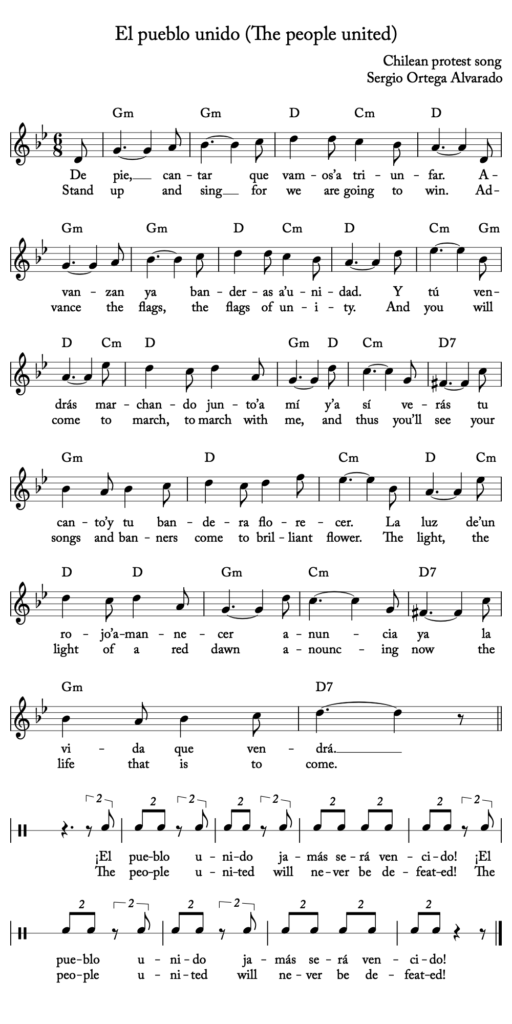
EL PUEBLO UNIDO

De pie, cantar que vamos’a triunfar.
Avanzan ya banderas a’unidad.
Y tú vendrás marchando junto’a mí
y’a sí verás tu canto’y tu bandera florecer.
La luz de’un rojo’amanecer
anuncia ya la vida que vendrá.

¡El pueblo unido jamás será vencido! ¡El pueblo unido jamás será vencido!

THE PEOPLE UNITED

Stand up and sing for we are going to win.
Advance the flags, the flags of unity.
And you have come to march, to march with me, and thus you’ll see
your songs and banners come to brilliant flower. The light, the light of a red dawn
anouncing now the life that is to come.

The people united will never be defeated! The people united will never be defeated!

I don’t know where or when this video was recorded.

Here is a recording by Inti Illimani. I don’t find it as exciting as the one above, but I had some trouble fitting the words to the melody when I was transcribing this song and here the words are clearer.
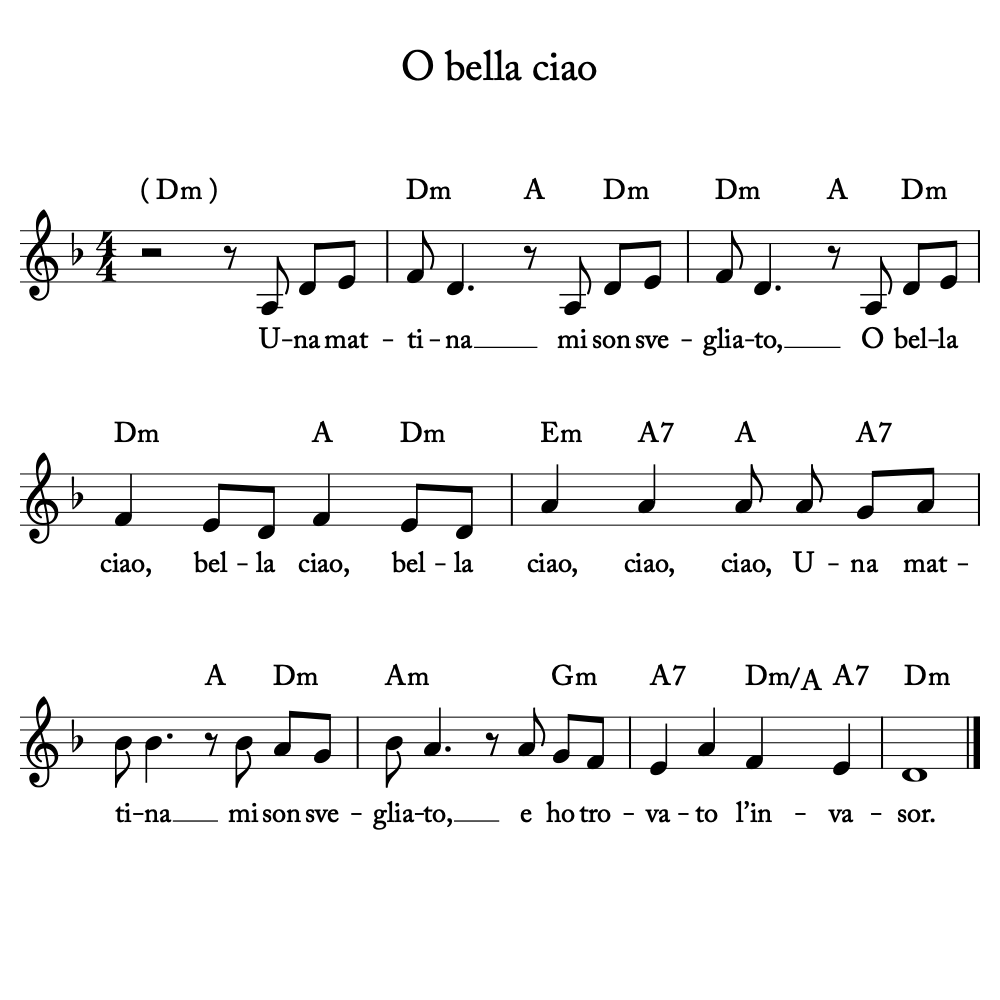
O bella ciao

Download PDF of O bella ciao

(We’ll have a version of O Bella Ciao for band available soon.)

Non violence is in its essence a method of communication by taking down walls and, if possible, making friends with the enemy and convincing them to change their ways. We always hope for that possibility. Often, we can do this work better through music than we can by yelling and arguing. Here‘s an interesting clip from The Tennesseean showing a confrontation at the No Kings demonstration in Nashville between the police, a group from The Proud Boys and a crowd of demonstrators. A lot of protestors were yelling and swearing; but a brass band stepped up and started playing O Bella Ciao. By the end of the song, the tension had dissipated and everybody, even the Proud Boys, were clapping and cheering for the music.

During World War II, this song of resistance was sung by the partisans. It is known and used widely in Europe and Latin America.  But it’s in Italian, not Spanish. O bella ciao is one of those melodies that can be deeply moving while also being adaptable for dancing.

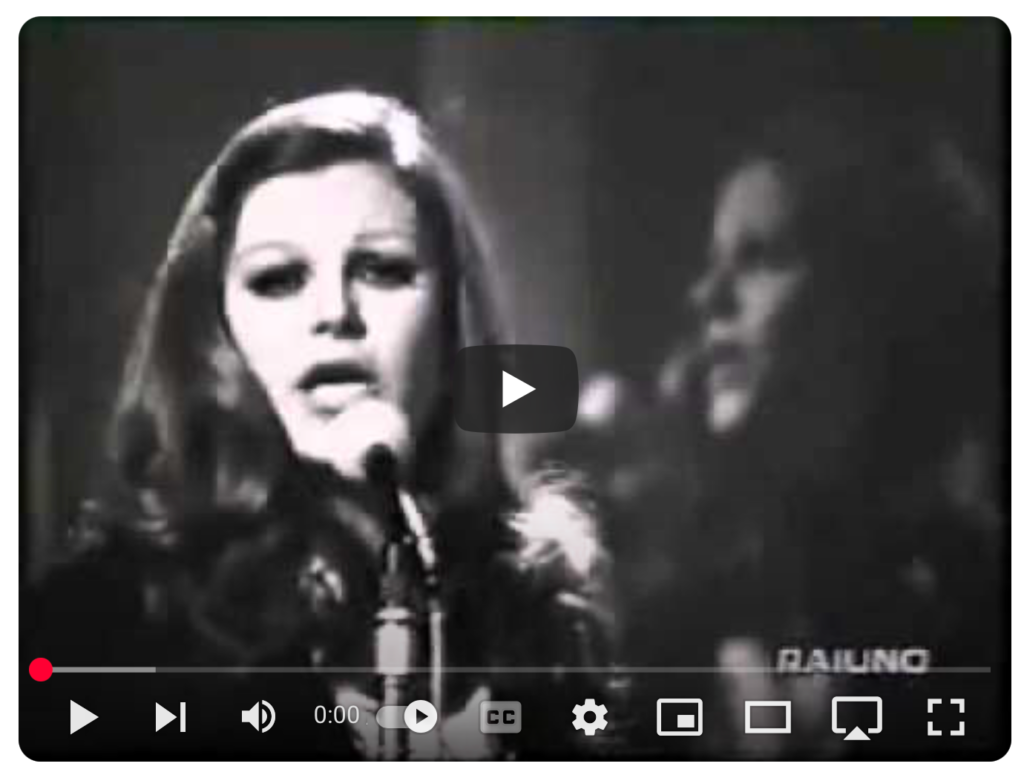
Here is a famous performance of it by the popular Italian singer Milva:

Milva singing O bella ciao

For a totally different take on O bella ciao, here is an scherzando arrangement for band.

If you would like to learn more about the song, try this Wikipedia entry.

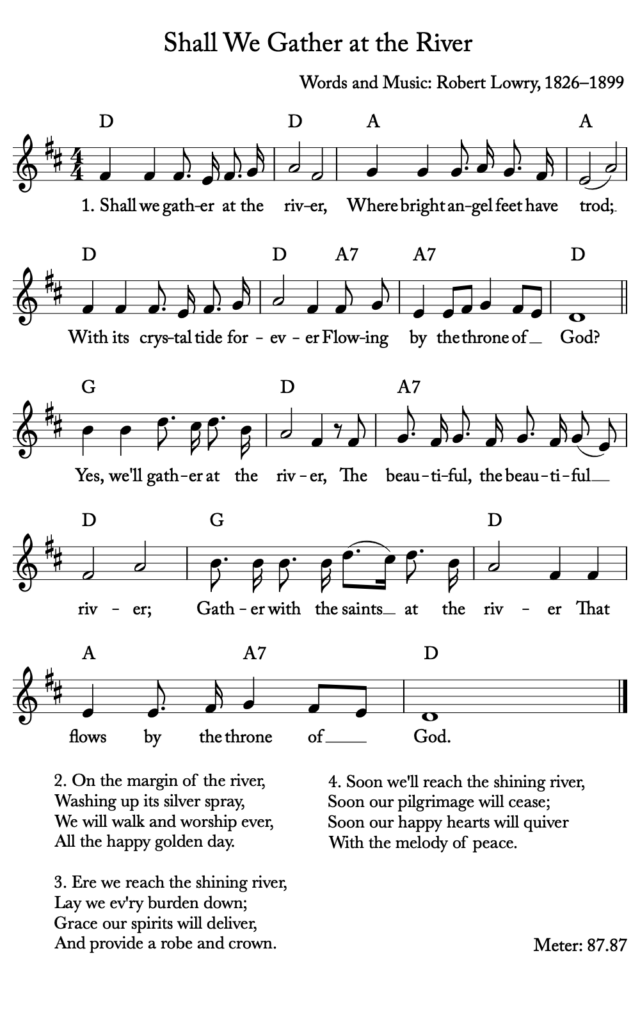
Shall We Gather at the River

Download PDF of Shall We Gather at the River

What is it about water that so many of songs of the spirit conjure with it? “Wade in the water, children! God’s going to trouble the water!”, ”Like a tree that is planted by the water, we shall not be moved,” “By the waters of Babilon we lay down and wept when we remembered thee, O Zion!” And, I guess I just love hymns; and this one is so happy and so deep that I just have to include it.

Well, of course there are a couple of versions of this. Burl Ives is so unselfconsciously hokey that you have to love him.

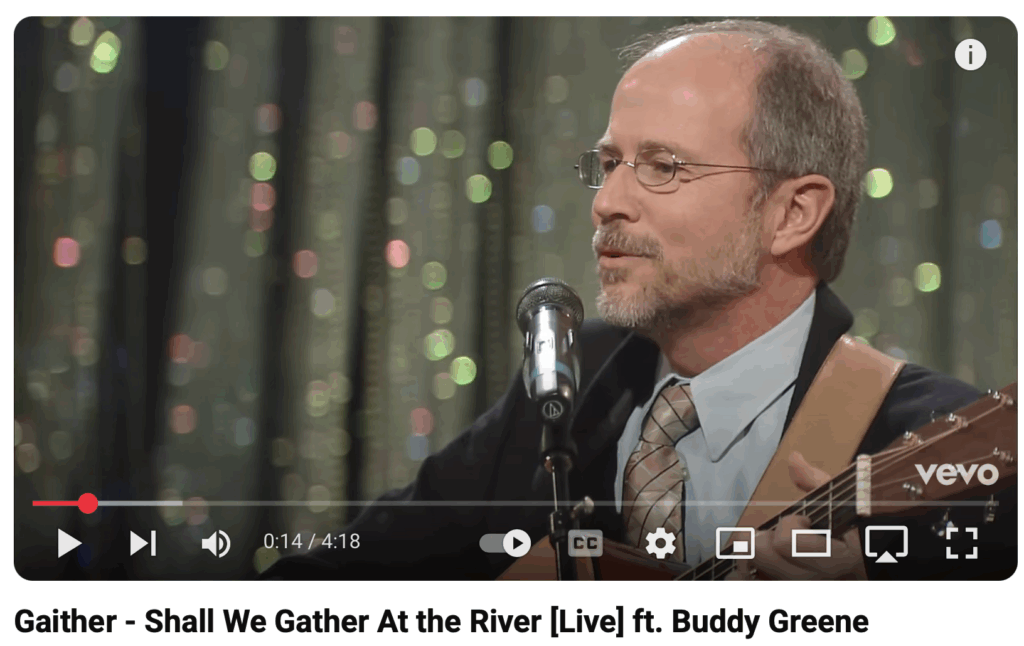
This next one by Buddy Greene is so sweet that you almost can’t listen to it. Well, actually, it’s under copyright so you can’t listen to it here even if you want to; you have to go to YouTube. Click on the image.

Though it’s basically such a jolly song, most of the recordings of Shall We Gather at the River take it slowly and with a kind of cloying sincerity. I have no idea who the Hee Haw Gospel Quartet is (are?)—maybe they were connected to that old TV show? —but I kind of like their homespun take on this old standard even if it is offered tongue-in-cheek. (I’m still waiting for an African American gospel version. If you run across one, please send me a link!)

What does the Lord Require of You

Download PDF of What does the Lord Require of You

Jim Strathee has here combined a verse from the Book of Micah with a variation of Pachelbel’s famous Canon in D. Strathee’s arrangement for choir and piano is copyrighted.

Here is a YouTube recording that includes a piano accompaniment. I haven’t been able to figure out where to purchase the sheet music for this arrangement and, anyhow, I can’t present it here because of copyright issues. The piano adds a bit of lushness, but the song works perfectly well as an a cappella round.

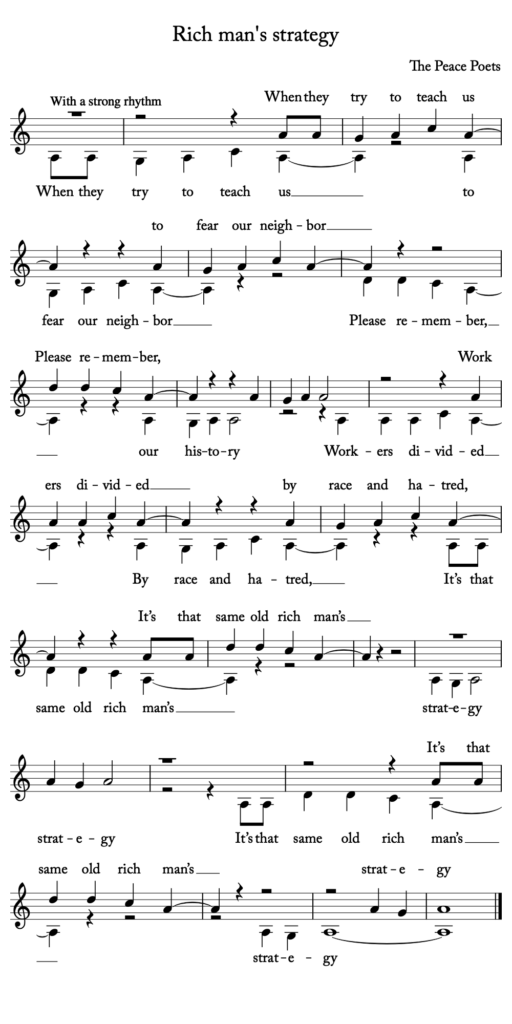
Rich Man’s Strategy

Download PDF of Rich Man’s Strategy

This is a very effective chant. It is primitive in the sense that it sticks to the pentatonic scale* (or, actually, the tetratonic scale, in that it uses only four notes). It works well with a drone on LA**, and some kind of very repetitive rhythmic ostinato. In the PDF of this song I have added in a steady drum beat.

If the response part to this is sung by a group of singers, there is a lot of room for harmonic improvisation; in fact, because of its harmonic simplicity, this would be a good song for less experienced singers to get a start on improvised harmony. If you stick to the notes in the pentatonic scale, you can’t really sing a note that is “wrong.”

*The pentatonic or gapped scale skips FA and TI. In other words the scale goes DO RE MI SO LA (DO). In this song, you start on LA instead of DO, so it goes: LA DO RE MI SO (LA).
**In movable DO solfege, DO is the tonic of the major scale and LA is the tonic note of the minor scale.

A library of music for the resistance

Featured

Welcome to LibertyScore.us, an on-line library of downloadable music that can be used in the struggle against authoritarianism. Music is one of the best ways to build solidarity and strengthen us all to keep going. These songs can be used for Demonstrations, Gatherings, Vigils, church services and other events where we need to channel our anger into creative, unifying channels.

I am a musician not a politician, so it seems to me that my best contribution to the struggle has to be musical. I am assembling and making available music for voice and/or instruments that can be sung or played at rallies and demonstrations, some may be useful in smaller settings, and other songs are appropriate for vigils and more reflective gatherings—and some of this music may be useful simply for the spiritual renewal of people in the movement.

The site is just starting up but I have uploaded a number of songs already. To find music, go to the menu-bar and click on the “Songs” link. As this work goes on, I hope to include some instrumental music, too.

Sound the Trumpet! Beat the Drum!

“Everyone loves a marching band, right?”

Rachel Maddow reported on Monday that at last weekend’s demonstration in Atlanta there was a moment when the police stood between the No Kings demonstrators and some counter demonstrators from The Proud Boys. Things looked tense; but then, a voice called out, “One! Two! Three!” and then drums, a tuba and trombone broke in with a compelling, quick tempo bass line, the saxophones joined in with a Klezmer dance tune. It was irresistible. And soon almost everyone was moving and clapping — including the Proud Boys group! While tempers remained high and there were still middle fingers waving, the joyful music brought the mood up and defused a situation that might have become violent. 

I keep hearing the question, where is the protest music of our era? It’s true that we don’t have the gospel and folk music singers that we had in the 1960s. Bob Dylan, Joan Baez, Bob Marley, Pete Seegar, Odetta, these are people from what is now a bygone era, but those voices came out of the baby boom era when a large percentage of the population were very young. Maybe we are listening in the wrong place for our music. We should listen, not at what is in the past, but to the music that is actually happening in our streets. Popular music has become very much a creation of the electronic studio and the internet; but our current situation demands that we get our from behind our devices and earphones—because we need to be in the streets. And the music needs to be music that is in the streets—and it probably needs to be loud. So, unless we want to be dragging our batteries and amplifiers around with us everywhere we go, we may need to relearn how to do portable noise, music not sung into microphones and from behind guitars on stages, but made from mallets, drums and brass.

“Everyone loves a marching band, right? Whenever a marching band comes through a town, people come out of their houses … music turns what might otherwise be a boring gathering into a fun time … music makes people dance and sing.”

Scott Langley of Tin Horn Uprising

I don’t know the name of Rachel’s band in Atlanta, but it might have been one of the Atlanta Freedom Bands, which represents Atlanta’s LGBT community with various band—Marching Band, Color Guard, Concert Band, and the MetroGnomes Stage Band. In Boston there is BABAM!, an association of volunteer musicians (many of them also associated withThe Freedom Trail Band, Boston’s LGBTQ band) who are available to create pick-up bands of available members for local demonstrations. I don’t yet have a comprehensive list of bands nationwide, but you can find a lot of them from Honk Festival

Yay!

Jake Sterling
LibertyScore.us

LibertyScore.us is my contribution to our musical presence at demonstrations, marches, vigils and rallies. My goal is to provide musicians with resistance songs and other music with downloadable sheet music that includes notated music, chord symbols, lyrics and, sometimes, arrangements. 

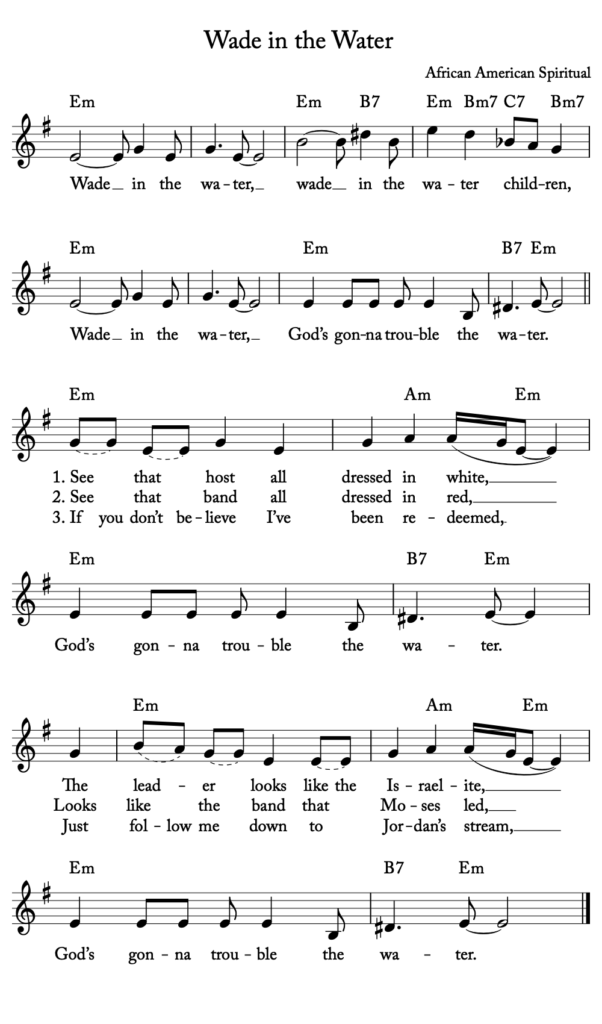
Wade in the Water

Download PDF of Wade in the Water

Download Arrangement for Band in E-flat (listen to audio below).

This is just one of my favorite hymns. Not exactly a protest song, but I think it would be great at a vigil or a memorial celebration. I’m not sure what the words mean, exactly, but somehow it comforts me when I feel trouble is coming. “Good trouble,” I hope!

In the PDF I’ve included a version with very simple chords plus another version that has been arranged for a choir. If you have singers who are good at improvising harmony, I’d go with that; but the arranged version is also excellent.

The rhythm on this is kind of hard to read (most American gospel, pop, and jazz music is); but, if you listen to a couple of recordings, you’ll find that it’s pretty easy to do it. Don’t forget to sing the eighth notes with a swing rhythm.

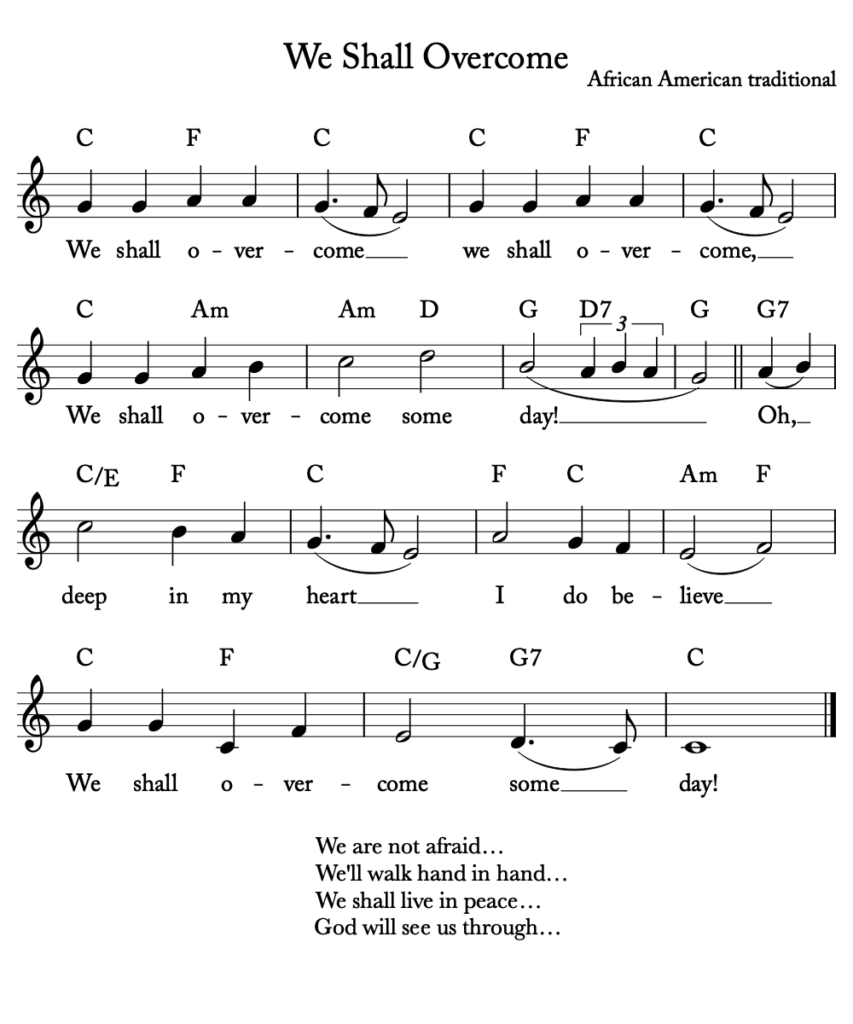
We Shall Overcome

Download PDF file of We Shall Overcome

Download PDF file of an arrangement for marching band of We Shall Overcome.

I’m not saying that this isn’t a good song but I can’t sing this any more. I’m old and I remember the Vietnam War, the assassinations of Dr. King and the Kennedy brothers, the war in Nicaragua, the Gulf War and the War in Iraq, the seemingly endless mass murders in schools, churches, synagogues, supermarkets and in the streets; and now the present horror show with concentration camps in authoritarian countries that are unaccountable to the citizens of the United States. The increase in stateless people in endless peregrination as they search for a place to settle has long been foreseeable given the totally predictable damage we are doing to the environment. Yet we who foresaw it have been incapable of doing anything to prepare for this time, while those who use cruelty and viscousness as their tactic of choice to enrich themselves leapt on the unprotected. The truth is, I am not certain that we shall overcome. Yet, the joy I take in building solidarity with the poor and the good-hearted is very great. What is a collection of protest songs without, We Shall Overcome? The PDF has two harmonized versions, the second one is very churchy, with a kind of Southern Baptist feel to it. You could play it on a Wurlitzer organ with the vibrato turned up high to get the full effect; and I have just added an arrangement for brass band for which I wrote a descant obligato for piccolo, which I am stupidly proud of.

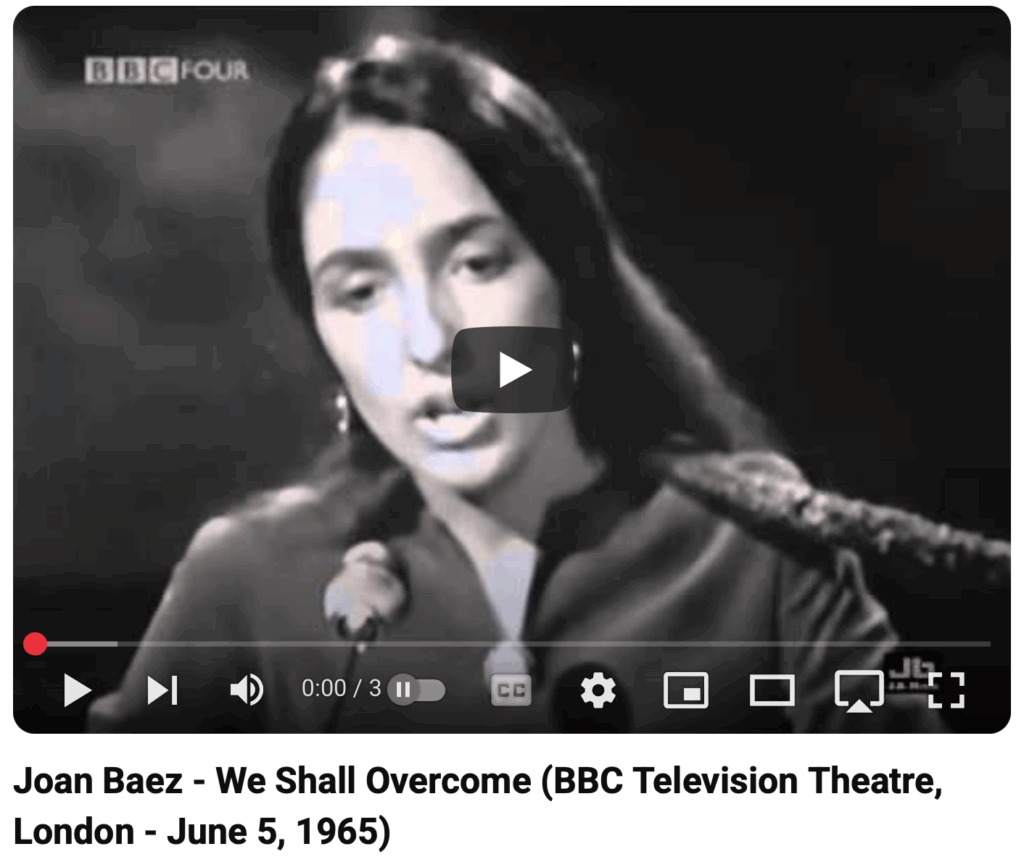
Here is a recording from 1965 of Joan Baez (who else?) singing We Shall Overcome.

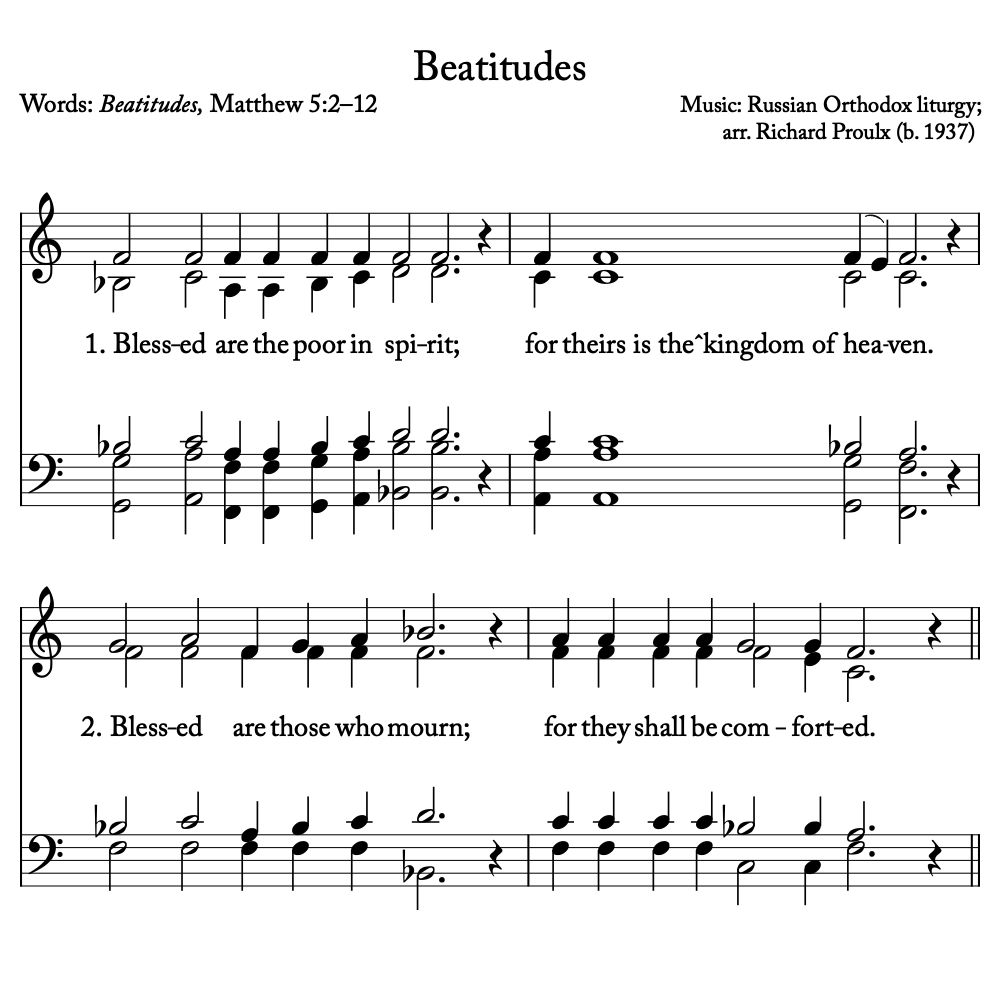
The Beatitudes

Download a PDF file of The Beatitudes

Chant from the Russian Orthodox liturgy — Matthew 5:2–12

I have a fantasy of getting together a small choir and singing this on the steps of the Capitol, maybe singing it repetitively—a lot of times—to make sure it is heard.

Below is an excerpt of this wonderful harmonized chant from the Russian Orthodox tradition. Download the PDF above for the full thing, or go to the Episcopal Church’s The Hymnal 1982 (hymn number 560).

You can hear this chant, beautifully sung by the choir of St. Patrick’s Cathedral in Fort Worth in the embedded YouTube recording below.

A note about Chant

This site is, of course, about politics, but on a deeper level it is about clearing and healing our spirits through singing. Chanting is a kind of active meditation that goes very deep. I’d like to do more of it in vigils and witnessing actions, moments when we want to influence the course of events with the power of our own inner centeredness and peace, rather than with anger, times when we come together to remember those who have died or who are imprisoned.

Most of my experience is within the Christian Church; but chant is found in all faiths and spiritual traditions. A good book about chant is, The Sacred Art of Chant, by Ana Hernandez; however, better to start by chanting rather than reading about chanting.

The Beatitudes sung at St. Patrick’s Cathedral, Fort Worth, Texas